Unknown's avatar

Talking about men’s violence (It seems like I’ve been here before)

Anybody pushing a ‘gender neutral’ approach to domestic – or sexual – violence is just a male violence enabler.

Men (mostly, but yes, some women too) don’t seem to like it when we talk about men’s violence against women.  The responses are nothing new and as yet never original,  so, as a result, I’ve written this to save me the bother of repeating the same thing over and over again because I am not going to stop talking about men’s violence against women and I don’t suppose men are going to stop finding that objectionable.  If I have sent you a link to this piece, it’s because

a) you have suggested that I don’t care about male victims

b) you refuse to accept than the extent of differences between men’s and women’s use of violence or the effects of that violence

c) you’re interpreting what I say as ‘all men are violent’

d) you’ve found it necessary to point out that women can be violent too

c) you have made some nonsense comment about feminism,  or

d) some combination of the above.

I want to see an end to men’s violence against women.  I’m campaigning to raise awareness of men’s fatal violence against women and for action to increase our understanding of the reasons behind the differences in men and women’s use of violence and their victimisation, so that we can reduce men’s violence against women.

Women who are murdered are most likely to have been murdered by a man.  Men who are murdered are most likely to have been murdered by a man.  Men are more likely to be violent than women.  Not all men are murderers, not all men are violent. Some women are murderers, some women are violent.

Gender and gender differences – the ways that many of us behave in ways that are seen as being like a ‘typical man’ or a ‘typical woman’ – are socially constructed.  They are not biological, they are not inevitable.  Not all women and not all men conform or want to conform to these gender differences, many of us sometimes do and sometimes don’t. Because gender differences are socially constructed, it means we can change them.  The stereotypical gender differences between women and men are a way of keeping women and men unequal. At the same time, different doesn’t have to mean unequal.

All men benefit from inequality between women and men.  This doesn’t mean that some women are not in more advantageous positions than some men. It doesn’t mean all men are the same.  It doesn’t mean that all women are the same.   It doesn’t mean that sex is the only important basis for inequality.  It doesn’t mean that everyone wants it to be that way.

Men’s violence against women is a cause and consequence of inequality between women and men. It doesn’t have to be that way. If enough of us decide to do things differently we can change the world.  Men don’t have to be violent, towards women or other men. Men can end male violence if enough of them want to.  The thing is, this won’t happen if too many men – and/or women – refuse to see that men’s violence is a problem.  The changes that will reduce men’s violence against women will also reduce men’s violence against other men, they will probably also reduce women’s violence.

I want to see an end to men’s violence against women.  What this means is “I want to see an end to men’s violence against women.”  It doesn’t mean that I do not care about other forms of violence.  It doesn’t mean that I do not feel any compassion towards male victims of violence.  It doesn’t mean that I don’t care  or that I celebrate if men are killed – and that is true whether they’re killed by a woman, or, as is more likely, by another man.

A straw man argument  is misrepresentation of someone else’s position to make it easier to attack or undermine that position.  When men – and it usually is men, but not always – attack me for caring about women killed though men’s violence, by suggesting that this means I don’t care about men who are victims of violence (whether from women, or as more likely, other men), they’re using a straw man argument.  They saying that because I care about men killing women, I can’t care about men who are killed, to attack the fact that I care about women who are killed. This may or may not be, as suggested by a friend of mine, Louise Pennington, because they do not care when men kill women. The thing is, whether they intend it or not, their attacks and their refusal to accept men’s violence as the  problem means that it is less likely that we’ll be able to make the changes that will make us all safer.  And even though men kill more men that they kill women, who benefits from things staying the same? Yep.  Men. Even the nice ones.

Unknown's avatar

More British women killed though men’s violence last year than British troops killed in Afghanistan in the last 3 years

Nigella Lawson used the phrase  ‘intimate terrorism’ to describe her abuse from Charles Saatchi in court in December last year.  It is a derivative of the more useful term ‘patriarchal terrorism’ which captures not only that men are overwhelmingly the perpetrators and women the victims,  but the wider cultural context – patriarchy – in which men’s violence against women takes place.  The concept of terrorism reminds us that abuse is physical and deadly but also about coercion and  reinforcing ideologies of dominance.

The UK’s military role against the Taliban in Afghanistan has claimed the lives of 99 members of the Army, RAF, Royal Marines and special forces in the last three years.  Regardless of, and not discounting the arguments for or against British military intervention and also not wishing to denigrate the death of even one person –  military or civilian, or  on either side –  the deaths of British military personnel are far outnumbered by the deaths of  140 women in the UK who were killed though men’s violence in one year alone.

I started keeping the list of the names of women killed in January 2012.   Many people know the statistic than ‘two women a week are killed through domestic violence in England and Wales ‘ but I thought keeping a list of the names of women killed made the horror of what is happening feel more real.  Since I started the list, I’ve counted 264 dead women: 120 in 2012, 140 in 2013 and already 4 in 2014.

When I started keeping the list, I was shocked and angry about the lack of attention given to the murders of women, and what feels like a refusal to look at the links between the different forms of men’s violence against women. It’s not only women being killed by their partners or ex-partners but by their sons, grandsons, fathers, business associates, as well as by rapists and robbers.

I launched a campaign “Counting Dead Women” because I want to see a fit-for-purpose record of fatal male violence against women. Unless we have an accurate picture of what is going on and make connections between the different forms of sexist murders, we will not stop men killing women.  264 dead women later and I’m not going to stop counting and naming the women killed until official records are being kept and the government is doing everything that it can. I’m asking anyone who feels the same and who hasn’t already done so to sign my petition demanding change.

I’d like to thank @thedwellproject for the analogy to British military deaths in Afghanistan in this post by Eddie. For Our Daughters have also compared women killed though male violence to British troops in Afghanistan, Iraq and N. Ireland.  

Unknown's avatar

Clare’s Law: the domestic violence disclosure scheme

The basic principle of allowing women to find out if a partner/prospective partner has a violent history is sound.  I’ve spoken to several women who have had violent relationships who have told me that they think it would have made a difference to them, to have what we might call ‘warning signs’ confirmed.

But I have a number of concerns:

  • Most domestic violence is not reported to the police, estimates vary but it is thought that only 24-40% of domestic violence is reported to the police, so the possibility of false negatives is high, “no history on record” is not the same as “no history” or “no risk”.  Women are psychologically undermined through domestic violence, they learn to question and doubt themselves, being told that a  man who is showing signs of coercive/aggressive/violent behaviour has no record, may make a woman more likely to doubt what is happening or to blame herself.
  • Will there be sufficient specialist help available if a woman finds out a man has a violent history? We know that specialist services are facing unprecedented cuts. Women’s Aid research has shown that in 2013 there are 21 fewer specialist refuge providers in 2013 than there were in 2010.
  • What if she has children? (By him or a previous partner)  Will there be pressure on her to leave from social services or face child safeguarding enquiries?
  • If she doesn’t leave and is killed, will agencies use the fact that she knew as a way of absolving themselves of any responsibility?
  • What happens to the man? Presumably, if the woman chooses to leave him, he will simply move on to another relationship. Are perpetrator programmes available?
  • Will a woman be pressured to report a crime if she wants to use the scheme? Not all women want to and pressurising a woman to take action before she is ready could put her at further risk.

Clare’s Law needs to be resourced and that means investment in, not cuts to, specialist women’s services.

I’m concerned that the government is going for quick fixes and potential headlines.  The number of women killed though domestic has remained consistent for over 10 years. Yet that’s not the whole story.  It’s being reported today that 88 women were killed through domestic violence last year, but I’ve counted 120 women killed through men’s violence, including 16 women who were killed by their sons.  Clare’s Law would not have helped them. We’re not being told the whole story about men’s fatal violence against women.  A long term, wide reaching approach is needed.  Men’s violence against women and girls is a cause and consequence of inequality between women and men. Quick fixes are not the solution.  Clare’s Law, may make a difference to some women who request information, but it’s not enough.

Unknown's avatar

25th November – What’s In A Name?

Mirabel sisters

In July 1981, at the first Feminist Conference  for Latin American and Caribbean Women in Bogota, Colombia, 25th November was declared an annual day of protest, the International Day Against Violence Against Women, in memory of three sisters who had been murdered.  Patria, Maria Teresa and Minerva Mirabel were assassinated in a ’car accident’ in the Dominican Republic in 1960. They were political activists, killed for their involvement in efforts to overthrow the fascist government of Rafael Trujillo.  At that first conference, women linked and denounced all forms men’s violence against women from domestic violence, rape and sexual harassment to state violence including torture and abuse of women political prisoners.

On 6th December 1989,  Marc Lépine shot 14 female  students  dead and injured another 10 at the University of Montreal, Canada claiming he was ‘fighting feminism’.  This led to  a group of men in Canada launched the first White Ribbon Campaign in 1991.  The White Ribbon Campaign has become a global campaign to ensure men take more responsibility for reducing the level of violence against women.  I support men’s acknowledgement of their role in ending violence against women, it is essential for this to happen if we are going to end men’s violence against women and girls.

On December 17, 1999, the United Nations General Assembly designated 25 November as the International Day for the Elimination of Violence Against Women. The UN invited governments, international organisations and NGOs to organise activities designated to raise public awareness of violence against women on this day.

Increasing though, the 25th November is referred to as White Ribbon Day by the majority of the minority of people actively interested in ending men’s violence against women and girls.  The campaign by men overshadowing, not complementing, the International Day for the Elimination of  Violence Against Women.  Based on a huge assumption about the founders of White Ribbon Day,  one  might be tempted to question the race and sex dynamics at play when a campaign founded by white men eclipses a campaign founded by women of colour.

Sadly, many even fail to take the time to understand even the central them of ‘White Ribbon Day’ as illustrated by an email a colleague of mine received from an organiser of a ‘white ribbon event’ who told her that their day would be ‘for all victims of domestic violence, because men can be victims too’, simultaneously erasing the linking of the different forms of men’s violence against women and the campaign for men to take responsibility for their violence against women.

Men’s violence against women is endemic:

  • globally 35% of women have experienced either physical and/or sexual intimate partner violence or non-partner sexual violence (World Health Organisation)
  • In Japan 15% of women reported physical and/or sexual violence by an intimate partner in their lifetime; in Ethiopia it is 71%
  • 17%of women in rural Tanzania, 24% in rural Peru, and 30% in rural Bangladesh reported their first sexual experience as forced
  • 66,000 women are killed through men’s violence every year, in the USA four women are killed though men’s violence every day
  • In the UK, 120 women were killed by men in 2012, so far in 2013, more than 100 have been killed; the Home Office estimates that  69,000, women are raped every year.

UK media reports of violence against women and girls disproportionately cover violence against white and middle-class women in comparison to those of women of colour and working class women (unless they are sensationalising race and/or other oppressions, such as murders of prostituted women) and I do not want to contribute to this generally or specifically in relation to the erasure of Patria, Maria Teresa and Minerva Mirabel from the history of femicide:  men’s fatal violence against women.

Women’s activists have marked November 25 as a day to fight violence against women since 1981.  For me the 25th November is The International Day for the Elimination of  Violence Against Women.  It is about recognising the global nature of men’s violence against women. It is about standing side by side with my sisters.

On The International Day for the Elimination of  Violence Against Women this year, I’ll be commemorating the UK women killed through suspected male violence this year on the twitter account @countdeadwomen.  I will start with the 2nd January when Janelle Duncan Bailey, 25 was strangled by ex-boyfriend Jerome McDonald.  Every 10 minutes, I will move on and tweet the next date on which a woman was killed and the name of the women and the man convicted or primary suspect for her killing.  If I start at 6.00 am, and name a women every 10 minutes, I’ll still be naming women at midnight, 18 hours later.

Unknown's avatar

Don’t these feminists just need to lighten up and have some Halloween fun?

Artist Emma Bolland took and shared on twitter a photo of a mannequin in the window of the Amazing Party Company fancy dress shop in Leeds.  After seeing the photo, I called the shop to complain, by this time they had removed the knife from her chest, they told me “It isn’t a woman who has been stabbed.  It’s a zombie nurse.  Zombie’s don’t really exist. It’s just a bit of fun”

The stereotype of the ‘sexy nurse’ isn’t fun, it is objectification, 90% of nurses are women, it is reducing the role of a nurse to a woman’s sexual agency. It is pure and simple sexism. A UK poll found that for men a nurse was the most sexually-fantasized-about job. Reducing nurses to sex objects is an insult to the hard work and professionalism of the thousands of women in nursing and contributes to the devaluing of the role and towards sexual harassment of nurses in their place of work.

As the Amazing Party Company – who describe themselves as a family run retail business –said “Zombie nurses don’t exit.”  Zombie nurses don’t exist, but stabbed women do, stabbed nurses do. I’d like to see them explain the fun of stabbed nurses to Penny and John Clough, whose daughter, 26 year old nurse Jane Clough, was stabbed 71 times by her former boyfriend Jonathan Vass before he slit her throat in the hospital car park.  Or the family and friends of 25 year-old estate agent Nicole Waterhouse from York or 28 year-old Gabrielle Stanley from Doncaster, both of whom were stabbed to death this month.  From my records of women killed through suspected male violence I know that 33 UK women were stabbed to death by violent men in 2012.  At least a further 11 women have been killed though stabbing so far this year, probably more – if 2012 was typical, stabbing seems to be the most frequently used form of murder. Stabbed nurses, stabbed women, I’m failing to see the fun side.

Those stabbings take place within a wider context of fatal male violence against women.  In total, I know of 120 women killed though male violence in 2012 and a further 100 already suspected so far this year. Not fun.

Jane Clough  had written in her diary that she thought Jonathan Vass would try to kill her after she ended their relationship.  In the December before he murdered her, Vass was charged with 9 counts of rape and 4 of assault against Jane. Against the reported wishes of both the police and the Crown Prosecution Service, Judge Simon Newel granted him bail.  Making male violence against women fun contributes to a society that doesn’t take the threat of male violence against women seriously. A society that doesn’t taken male violence against women seriously is one in which bail can be  granted to men with a history of violence against women.

I’m still not finding this fun.  Happy Halloween Amazing Party Company.  Did you make  a good profit out of the fun that is fatal male violence against women?

Image

Unknown's avatar

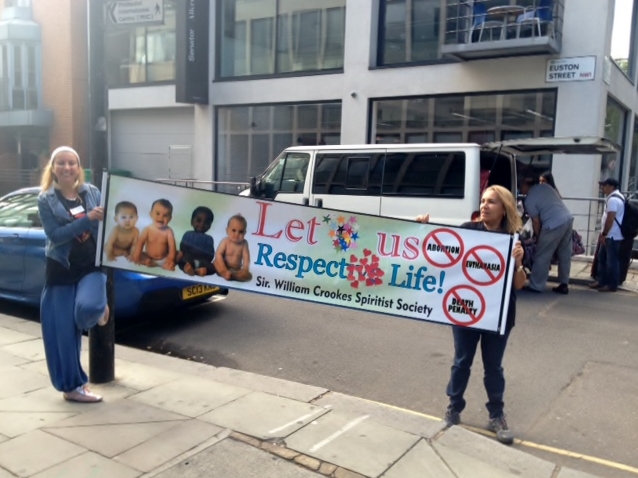
Respecting Life

Respecting Life photo

Yesterday afternoon, in Euston, central London, I walked past a small group of women with a banner urging us to “Respect Life”, to say no to abortion, euthanasia and the death penalty. They belonged, as is clear from their banner, to the Sir William Crookes Spiritist Society.  I rejected one of their leaflets (which I now regret) even so they were happy for me to take a photo of them.

Of course I am one of the pro-choice majority when it comes to abortion.  I oppose forced pregnancy, I oppose forced abortion.  Women’s rights must include bodily autonomy and the freedom to choose what is best for them, albeit within the confines of patriarchal society.  Being pro-choice does not mean the same as being pro-abortion.  It does mean   making sure that women are supported, that though promoting and increasing access to contraception we reduce unwanted pregnancies, that through education we ensure that everyone understands how to avoid getting pregnant, as well as how to get pregnant.  Pro-choice means increasing ease of access to legal, early, safe abortion.  Pro-choice means not judging women who have abortion (s). I’ve heard that some infertile women oppose abortion, criticising women who have an abortion as ‘selfish’ when some of us can or could not have a child. I can’t see how reducing another woman’s liberties can ease the difficulty of infertility.   Women should never be reduced to baby-making machines, just as those of us who cannot have babies are no less women.

Pro-choice means believing that every child should be a wanted child, that seemed so clear to me until a few days ago, until I thought about sex-selective abortion as a result of a failure to prosecute two doctors who had carried out abortions on the basis of the sex of the foetus.  I am not comfortable with the position that  ‘a woman’s right to choose’ can be extended to femicide.  Like so often is the case for a radical feminist, the answer lies in ending the inequality between women and men.  The answer here is to change and challenge those beliefs that see a woman as ‘less than’ a man, a girl as ‘less than’ a boy. Until this happens, I remain uncomfortable with sex-selective abortions. I oppose femicide, but a foetus cannot be more important than a woman,  wanting every child to be a wanted child cannot be extended to forced pregnancy.  Being pro-choice is respecting life, it is respecting the lives of women and children.

Euthanasia, assisted suicide and/or the right to die should never become the duty to die for fear of being a burden on others, should never become elder abuse or  neglect.  The costs and difficulties of care  cannot be permitted to become reasons to kill.  It’s clear that strong laws, an ethical legal framework and guidance are necessary.  But being pro-choice and pro-bodily autonomy mean respecting the right to choose to die. Respecting life means respecting the right to die.

The Sir William Crookes Spiritist Society is opposed to the death penalty.  They do not think that the state has the right to murder murderers and violent, repeat sex offenders.  And neither do I.  Neither does the UK government, the death penalty was abolished  for murder in 1965, (in 1973 in Northern Ireland).  It was not finally abolished for high treason, piracy with violence, arson in the royal dockyards or espionage until 1998. According to Amnesty, across the world  21 countries carried out 682 executions (excluding China where figures are not released but are known to be very high) in 2012.   The top five executing countries in the world are China, Iran, Iraq, Saudi Arabia and USA, with Yemen closely behind. I hate violence but the death penalty is no solution.  Though I understand the anger,  the hatred for and the desire to punish those who abuse, rape and kill, the state should not be a killer. It’s illogical to argue that murder  is wrong through murdering.  Statistical evidence does not support that the death penalty deters crime.  In the USA for example, murder rates in states that do not impose the death penalty have remained consistently lower than in states with the death penalty.  It is also used disproportionately against those who face structural discrimination, people from black and minority ethnic groups. Respecting life means that the state should not be sanctioned to kill.

Worryingly, the Sir William Crookes Spiritist Society say that they provide counselling and moral education for children. Worryingly, I say, because  I don’t believe abortion, euthanasia and the death penalty are the same, I don’t believe that saying “No!” to them all is respecting life.  I don’t want those that conflate them to have any role whatsoever in educating children.  Respecting life does mean respecting the lives of killers and rapists. Respecting life means respecting choice, respecting life means respecting bodily autonomy. Respecting life means respecting women.  Respecting life means respecting the right to die.

Unknown's avatar

Femicide: UK women killed through suspected male violence January – August 2013

Many people know the statistic: ‘two women in England and Wales a week are killed through domestic violence‘; but how many try to connect with that and to feel the impact of what it really means?

Through naming the women killed, I’m trying to made the horror and unacceptability of what is happening to women feel more real. I began, in January 2012, by  recording the names of all women killed through domestic violence but as time went on, I wanted to make the connections between the different forms of fatal male violence against women. Since I started the list, I’ve counted 197 dead women.  I’m not going to stop counting and naming the women until I think the government is doing the same, ‘counting dead women’ and doing all it can to make the connections, making good its commitment to end male violence against women.  Please join me demanding action from the government by clicking here and signing my petition.

When I started keeping the list, I was shocked and angry about the lack of attention given to these murders, and what feels like a wilful refusal to look at the links between the forms and causes of violence against women. Male violence against women and girls is a cause and consequence of inequality between women and men, and until a government seriously approaches the issue from that perspective, women and girls will continue to be beaten, raped, assaulted, abused, controlled and killed by men.

The list below is the 78 UK women killed through suspected male violence so far in 2013.  78 women in  243 days, that’s one  woman every 3.1 days.

Janelle   Duncan Bailey 25 02-Jan
Akua   Agyueman 23 03-Jan
Anastasia   Voykina 23 07-Jan
Myrna   Kirby 57 11-Jan
Suzanne Bavette Newton 45 13-Jan
Virginja   Jurkiene 49 19-Jan
Chloe   Siokos 80 22-Jan
Debbie   Levey 44 28-Jan
Sasha   Marsden 16 31-Jan
Una   Crown 86 31-Jan
Hayley   Pointon 30 03-Feb
Pernella   Forgie 79 07-Feb
Ganimete   Hoti 42 11-Feb
Samantha   Medland 24 17-Feb
Alexis   Durant 42 20-Feb
Glynis   Solmaz 65 20-Feb
Dimitrina   Borisova 46 21-Feb
Victoria   Rose 58 02-Mar
Chantelle   Barnsdale-Quean 35 04-Mar
Susan   Cole 54 06-Mar
Christina   Edkins 16 06-Mar
Jennifer   Rennie 26 11-Mar
Daneshia   Arthur 30 18-Mar
Pamela   Jackson 55 last seen 20 March
Ellen   Ash 83 21-Mar
Mary   Roberts 50 27-Mar
Janis   Dundas 63 05-Apr
Deborah   Simister 45 08-Apr
Lisa   Clay 41 09-Apr
Mariam   Ali Shaaban Hussain Khesroh 24 11-Apr
Dawn   Warburton 40 13-Apr
Naika   Inayat 52 17-Apr
Jabeen   Younis 32 19-Apr
Irene   Dale 78 27-Apr
Heather   Arthur 50 29-Apr
Salma   Parveen 22 29-Apr
Christine   Baker 52 30-Apr
Margaret   Knight 77 01-May
Margaret   Mercati 63 15-May
Margery   Gilbey 88 24-May
Georgia   Williams 17 26-May
Yvonne   Walsh 25 02-Jun
Krishnamaya   Mabo 39 03-Jun
Myrna   Holman 76 03-Jun
Reema   Ramzan 18 04-Jun
Katie   Jenkin 20 08-Jun
Alice   McMeekin 58 08-Jun
Marianne   Stones 58 09-Jun
Lilima   Akter 27 14-Jun
Zaneta   Kindzierska 32 16-Jun
Mushammod   Asma Begum 21 20-Jun
Linzi   Ashton 25 29-Jun
Rania   Alayed 25
Louisa   Denby 84 01-Jul
Susan   White 51 01-Jul
Kate   Dixon 40 02-Jul
Denise   Williamson 44 05-Jul
Sabeen   Thandi 37 07-Jul
Shavani   Kapoor 35 10-Jul
Jane   McRae 55 17-Jul
Julie   Beattie 24 19-Jul
Rosemary   Gill 48 20-Jul
Alexandra   Kovacs 25 21-Jul
Jean   Redfern 67 22-Jul
Sarah   Redfern 33 22-Jul
Keisha   McKenzie 28 29-Jul
Linah   Keza 29 31-Jul
 
Anu   Kappor 27 04-Aug
Caroline   Parry 46 08-Aug
Mayurathy   Perinpamoorihy 06-Aug
Judith   Maude 57 11-Aug
Gail   Lucas 51 14-Aug
Orina   Morawiec 21 15-Aug
Julie   Connaughton 57 16-Aug
Jane   Wiggett 57 16-Aug
Sabrina   Moss 24 24-Aug
Merissa   McColm 31 25-Aug
Betty   Gallagher 87 25-Aug
Unknown's avatar

Quick fixes like changing gun control laws wouldn’t have saved the 13 UK women killed through suspected male violence in July 2013

This week the government published new guidance on gun control in the UK including a provision that those with a history of domestic violence should not be permitted to possess a firearm or gun.  The case of Michael Atherton who shot dead three women: Susan McGoldrick, Alison Turnbull and Tanya Turnbull on 1st January 2012 is painful evidence that this was needed and overdue.   Michael Atherton’s history of domestic violence was known to the police, but he was still issued a gun  license and legally owned six weapons.

However, gun controls would have prevented the deaths of none of the 13 UK women killed in July 2013 alone, through suspected male violence,  the same month that this legislation change was introduced.  This is because, of those 13 women none were shot:

    • 5 were stabbed
    • 2 were strangled
    • 2 were killed through blows from a bunt object
    • 1 was asphyxiated
    • 1 was killed through head injuries
    • 1 was burnt alive, and
    • 1 was so badly decomposed that post-mortem results have been inconclusive

The men arrested for the killings have all been known to the women:

    • In 5 cases the man arrested was a      husband/ex-husband of the women killed
    • In 5 cases the man arrested was a      boyfriend/ex-boyfriend
    • One man has been arrested for the murder of his daughter
    • One man has been arrested for the murder of his grandmother
    • 2 men have been arrested for the murder of a woman from the same      address.

If the government is serious about ending male violence against women it need to look at the causes.   Of course tightening gun control is a good thing , but women’s lives will continue to be taken if the focus is on headline grabbing quick wins.  Male violence against women and girls is a cause and consequence of inequality between women and men upheld by divisive gender standards. Until a government seriously approaches the issue from that perspective, women and girls will continue to be beaten, raped, assaulted, abused, controlled and killed by men.

Unknown's avatar

Femicide: UK women killed through suspected male violence January – July 2013

66 UK women killed through suspected male violence so far in 2013.  66 women in  212 days, that’s one  woman every 3.2 days.

Name Age Date killed
Janelle Duncan Bailey 25 02-Jan
Akua Agyueman 23 03-Jan
Anastasia Voykina 23 07-Jan
Myrna Kirby 57 11-Jan
Suzanne Bavette Newton 45 13-Jan
Virginja Jurkiene 49 19-Jan
Chloe Siokos 80 22-Jan
Debbie Levey 44 28-Jan
Sasha Marsden 16 31-Jan
Una Crown 86 31-Jan
Hayley Pointon 30 03-Feb
Pernella Forgie 79 07-Feb
Ganimete Hoti 42 11-Feb
Samantha Medland 24 17-Feb
Alexis Durant 42 20-Feb
Glynis Solmaz 65 20-Feb
Dimitrina Borisova 46 21-Feb
Victoria Rose 58 02-Mar
Chantelle Barnsdale-Quean 35 04-Mar
Susan Cole 54 06-Mar
Christina Edkins 16 06-Mar
Jennifer Rennie 26 11-Mar
Daneshia Arthur 30 18-Mar
Pamela Jackson 55 last seen 20 March
Mary Roberts 50 27-Mar
Janis Dundas 63 05-Apr
Deborah Simister 45 08-Apr
Lisa Clay 41 09-Apr
Mariam Ali Shaaban Hussain Khesroh 24 11-Apr
Dawn Warburton 40 13-Apr
Naika Inayat 52 17-Apr
Jabeen Younis 32 19-Apr
Irene Dale 78 27-Apr
Heather Arthur 50 29-Apr
Salma Parveen 22 29-Apr
Christine Baker 52 30-Apr
Margaret Knight 77 01-May
Sara Bates 33 04-May
Margaret Mercati 63 15-May
Margery Gilbey 88 24-May
Georgia Williams 17 26-May
Yvonne Walsh 25 02-Jun
Krishnamaya Mabo 39 03-Jun
Myrna Holman 76 03-Jun
Reema Ramzan 18 04-Jun
Katie Jenkin 20 08-Jun
Alice McMeekin 58 08-Jun
Marianne Stones 58 09-Jun
Lilima Akter 27 14-Jun
Zaneta Kindzierska 32 16-Jun
Mushammod Asma Begum 21 20-Jun
Linzi Ashton 25 29-Jun
Rania Alayed 25 Inconclusive, her body still has not   been found
Louisa Denby 84 01-Jul
Kate Dixon 40 02-Jul
Denise Williamson 44 05-Jul
Sabeen Thandi 37 07-Jul
Shavani Kapoor 35 10-Jul
Jane McRae 55 17-Jul
Julie Beattie 24 19-Jul
Rosemary Gill 48 20-Jul
Alexandra Kovacs 25 Inconclusive
Jean Redfern 67 22-Jul
Sarah Redfern 33 22-Jul
Keisha McKenzie 28 29-Jul
Linah Keza 29 31-Jul
Unknown's avatar

What about the men?

This is an update of a piece I wrote at the beginning of April about the men who killed women in the UK in 2012 and the methods they chose to do so.

Femicide is the killing of women by men because they are women, some include the killing of women by women where patriarchal views can be seen, in other words femicide is the killing of women  motivated, directly or indirectly, by misogyny and sexism.

I wrote  ‘Counting Dead Women’ on 25th March 2013 about  112 UK women killed in the UK through male violence in 2012, but through researching trial outcomes, that number was revised and had to be increased to 114. Repeating the exercise for this piece  eight  months later, again, the figure needs to be revised.  It now stands at 120.  120 women in the UK were killed through male violence in 2012, that’s one woman in the UK killed through male violence every 3.04 days.

The 120 women were killed by 118 men, four men were multiple killers. One man killed three women, three men killed two. Two women was killed by two men  and another by two men and a woman.

So far, 63 men have been found guilty of murdering 65 women.

Ten men, who killed 12 women between them have killed themselves. Five men shot themselves after shooting seven women, one man drowned himself after drowning his partner, one man hanged himself after strangling his partner and of three men who stabbed women they were or had been married to, one killed himself through poisoning, one by slitting his own throat and one in what is described as a serious self-harm incident whilst in prison.

17 men have been found not guilty or murder but guilty of manslaughter (two of which were culpable homicide sentences in Scotland). Even the name manslaughter renders women invisible.  Of the 17 men found not guilty of murder, nine pleaded diminished responsibility on the grounds of mental  health problems;  three pleaded loss of control and three that they did not intend to kill. (I’ve been unable to find details of the mitigating factors put forward by the remaining two men.)  Of the 17 men found not guilty of murder:  Four men  had killed women by stabbing them, one man by axing and stabbing, five men  had beaten women to death with an object, three men had strangled them, two men had kicked women to death, one man had smothered a women and one man killed a women through multiple injuries.  One of the men was found not guilty of murder but convicted of manslaughter with a sentence of only seven and a half years, despite killing a woman by stabbing/slashing her  11 times in what was described as a frenzied attack and a history of 25 court appearances for 44 offences, which include offences relating to domestic violence.

16 men killed their mothers, or have been accused of their killing. One man has been found guilty of killing his grandmother.  Five of the men who killed their mothers were found guilty of manslaughter/culpable homicide. Two men who killed their mothers also killed themselves.

14 cases have not yet been to trial and one man has been judged unfit to stand trial.

Five older women, aged between 75 and 88 years were killed by younger men, aged  between 15 and 43 years as they were robbed/mugged.  Two of the women died of head injuries, two were strangled and one was beaten to death with a hammer.

The average age of men in the UK who killed women in 2012 is 38. The average age of the women killed is 44. If the men who killed their mothers (or grandmother) and those who preyed on elderly women because of their vulnerability are removed, the average age of male killers becomes 40 and that of women killed becomes 39.

It’s often the case that details of how men have chosen to kill women are not reported until the case has gone to trial, so the following list is still incomplete. However, from what has been reported to date, the primary means selected by men to cause death to women have been:

  • Shot:                                                          7 women
  • Stabbed:                                                    34 women
  • Stabbed and beaten:                              4 women
  • Blunt force trauma:                               7 women
  • Strangled:                                                 12 women
  • Asphyxiation :                                          4 women
  • Strangled & asphyxiation:                     3 women
  • Strangled, beaten and stabbed:           4 women
  • Drowning:                                                 1 woman
  • Hammer injuries:                                    4 women
  • Stabbed/axed/slashed:                          4 women
  • Multiple injuries from kicking and beating:

                           8 women

  • Burned:                                                     1 woman
  • Fire:                                                            2 women
  • Head Injuries:                                          14 women
  • Deliberate Car Crash:                             1 woman
  • Body still not found:                               1 woman

When we look at women killed by men, it is important that we name men’s violence.