Unknown's avatar

Femicide – Men’s Fatal Violence Against Women Goes Beyond Domestic Violence

I wrote this piece for Women’s Aid’s magazine Safe:

The Office for National Statistics released findings from the 2013/14 Crime Survey for England and Wales on 12 February. Men continue to be more likely to be killed than women, there were 343 male victims compared to 183 female victims (of all ages including children and babies). Court proceedings had concluded for 355 (55%) of 649 suspects relating to 536 homicides.  For those suspects where proceedings had concluded, 90% (338 suspects) were male and 10% were female (38 suspects). Men are more likely to be killed, but their killers are overwhelmingly men. Women are less likely to be killed, when they are, they are overwhelmingly killed by a man.  When we’re talking about fatal violence, we are almost always talking about men’s violence.

The words homicide, from homo “man” and cidium “act of killing”, and manslaughter “ma” and “slæht or slieht” “the act of killing”  are identical etymologically but have developed different legal meanings.  Like the word “murder” both could be described as being ‘gender neutral’, but they are not, both render the killing of women invisible.  The word femicide seeks to address this.  The first modern and feminist definition of ‘Femicide’ is attributed to Jill Radford and Diana Russell (1991). They used it in the context of feminist analysis of men’s violence against women to address the sex-specific killings of women. Whilst some contentions remain over a definition, the definition ‘the killings of women because they are women’ is most frequently used. As well as women killed through intimate partner violence, femicide includes (but is not limited to): women killed by other family members, the torture and misogynist slaying of women including serial killings, the killing of women and girls in the name of “ honour”, targeted killing of women and girls in the context of armed conflict, dowry-related killings of women, female infanticide and gender-based sex selection feticide, killings of women due to accusations of sorcery and/or witchcraft, the deaths of women associated with gangs, organiSed crime, drug dealers, human trafficking and the proliferation of small arms, the killing of women and girls because of their sexual orientation and/or gender identity and FGM related deaths. Femicide can include women killed by women if the motive is associated with sexist or misogynistic patriarchal values, but is overwhelmingly perpetrated by men.

Femicide is a global issue.  About 66,000 women and girls are violently killed every year, according to a 2012 report by the Small Arms Survey.1 But comparing county-by-county data is challenging, partly because there isn’t a globally accepted definition, or even a globally agreed need for a definition, but also because most countries’ data-collection systems do not record the necessary information, whether that is the sex of the victim and perpetrator, their relationship or any known motives for the killing.  The data that is available suggests that countries with the highest femicide levels correspond to those with the highest rates of fatal violence. El Salvador has the highest femicide rate (12.0 per 100,000 female population), followed by Jamaica (10.9), Guatemala (9.7), and South Africa (9.6). Half of the countries with the top highest estimated femicide rates are in Latin America, with South Africa and Russian and Eastern European countries having disproportionately high rates.  It should be noted that high rates of female infanticide, sex-selective and forced abortion challenge the absence of countries including India and China  from this data. England and Wales’ femicide rate, by comparison, was 0.66 per 100,000 female population for 2013/14.

The ONS findings for 2013/14, consistent with previous years, found that women were far more likely than men to be killed by partners or ex-partners than men.  84 women, around 53% of female homicide victims (over 16) had been killed by their current or a former partner, compared to 23 men (7% of male victims over 16).  The ONS definition of partner/ex-partner homicide includes  killings by a “spouse, cohabiting partner, boyfriend/girlfriend, ex-spouse/ex-cohabiting partner/ex-boyfriend/girlfriend and adulterous relationship” but also “lover’s spouse and emotional rival”.  Combining data for 2011/12 and 2013/14, the ONS tell us that of 57 men killed in partner/ex-partner homicides, 21 of them, over a third, were killed by a man.  Of these 21 men killed by men in the context of partner/ex-partner homicides, 14 of them were killed by a lover’s spouse/love rival.  Of 249 women killed in partner/ex-partner homicides over the same 3 years, 247 were killed by a man, one by a woman (in one case the primary suspect is listed as unknown).  None of the female victims of partner/ex-partner homicide were killed by the spouse of their lover or an emotional rival. Similarly, no male victims of partner/ex-partner homicide were killed by a female spouse of their lover or a female emotional rival. Not only are men killed in the context of an intimate relationship less likely to be killed by their actual partner or ex-partner, they are much more likely than women to be killed by someone of the same sex.

Another important difference between women and men killed in the context of intimate partner violence is the history of the relationship.  When men kill women partners or ex-partners, this usually follows months or years of them abusing her, when women kill male partners or ex-partners, it is usually after months or years of having been abused by the man they have killed.2 So, there are four important differences when we compare women and men killed in the context of a current or previous intimate partnership (figures from the ONS 2011/12 to 2013/14 data):

  • Far fewer men than women are killed in the context of intimate partner violence (57 v. 249)
  • Men are much more likely to be killed by the spouse of a partner or a love rival (14/57 v 0/249)
  • Men are much more likely than women to have been killed by someone of the same sex (21/57 v 1/249)
  • Men are more likely to have been killed by someone they were abusing, women are more likely to have been killed by someone they were being abused by.

If we look at men who kill women (who are not current or ex- intimate partners), it is clear that they have more in common with men who kill female current or former  partners, than the much smaller number of  women who kill male former partners. The concept of femicide, making connections between all forms of men’s fatal violence against women provides a more useful theoretical framework than comparing people killed in the context of intimate partner relationships across the sexes. Sex inequality in patriarchal society cannot be ignored.

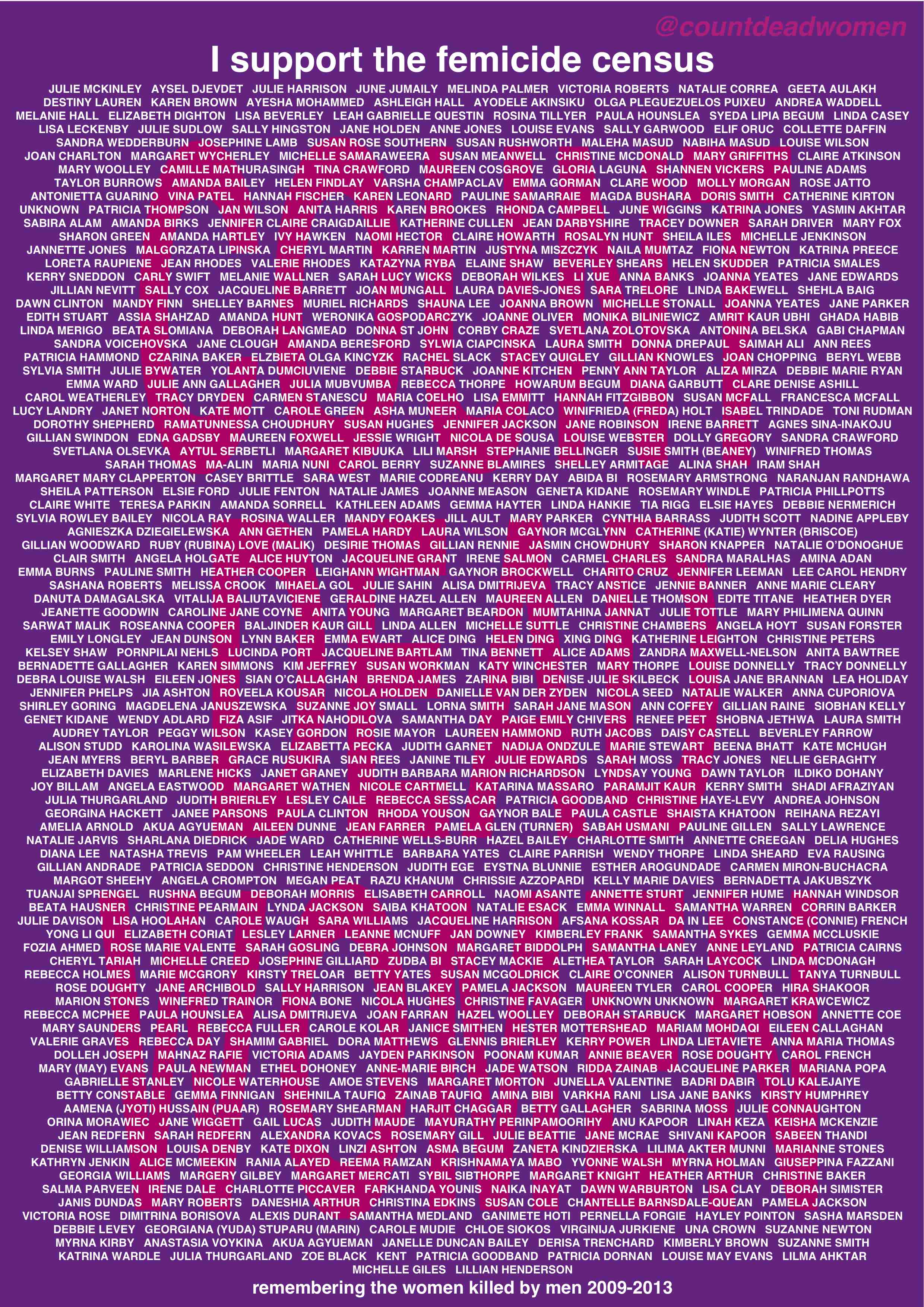
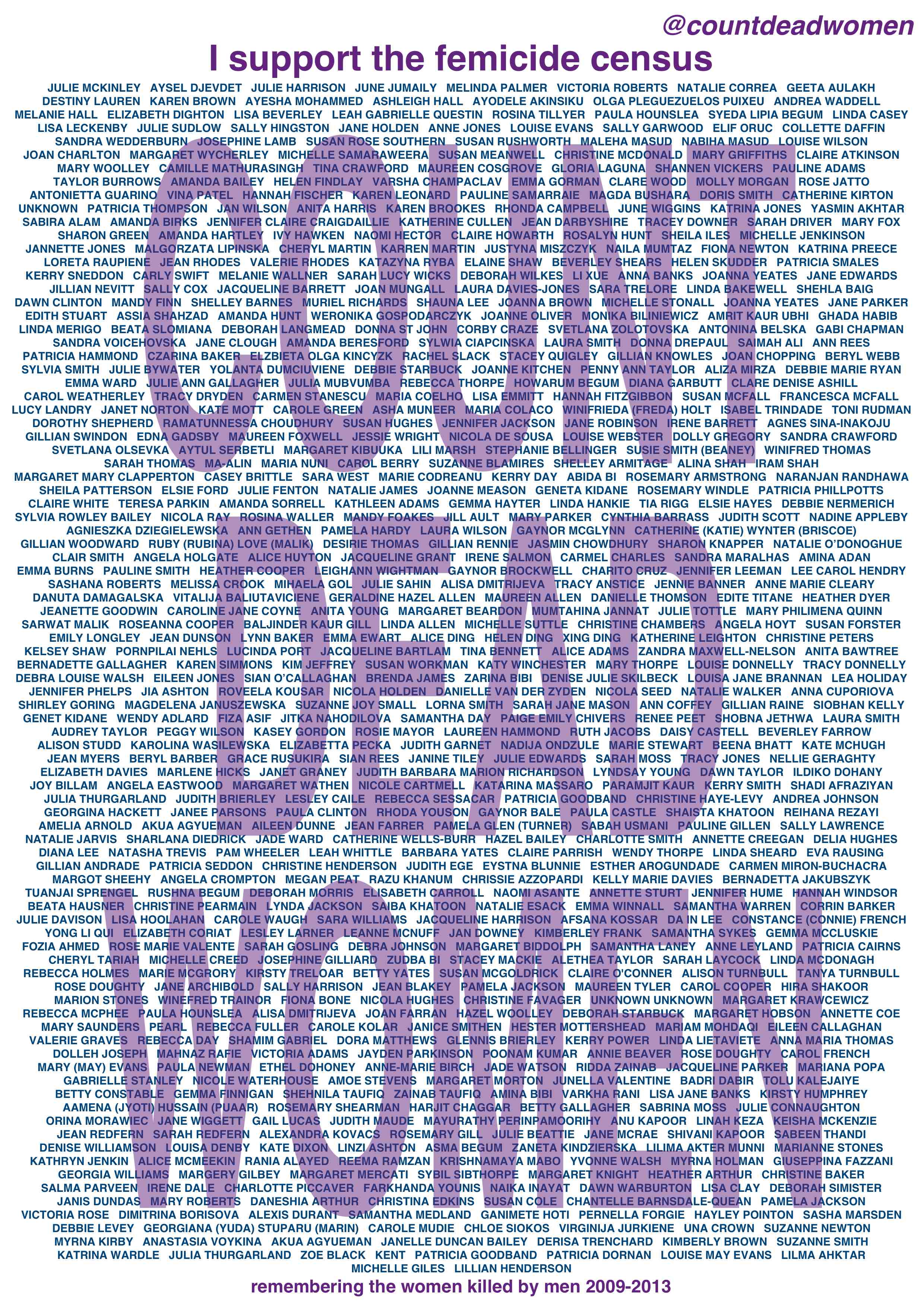
Since January 2012, I’ve been recording and commemorating UK women killed by men in a project called Counting Dead Women.  Looking at my own records for the same year as the ONS data, the next biggest group of women killed by men was women killed by their sons.3 Between April 2013 and March 2014, at least 12 women were killed by their sons, two more by their son-in-laws, three by their grandsons and one by her step-grandson. These patterns are not replicated in rates of women killing older male relatives: fathers, fathers-in-law or grandfathers. A further three women were killed by their fathers, and one more by her step-father.

Male entitlement is a deadly seam running through male violence against women, whether coercive control, rape, prostitution, trafficking or femicide.  Prostitution, pornography and trafficking are forms of violence against women, reducing women to commodities, possessions and objects for market exchange. Men are the purchasers, controllers and profit-makers, this market of women cannot be extricated from a context of inequality between women and men. At least 5 women killed last year (the same year as the ONS data) were women exploited through pornography and/or prostitution. There were over 64,000 sexual offences recorded by police last year, overwhelmingly committed by men, with young women those most likely to have experienced sexual assault. 1.4 million domestic violence assaults against women were recorded. When men kill women, regardless of their relationship or lack of it, they are doing so in the context of a society in which men’s violence against women is entrenched and systemic. When misogyny, sexism and the objectification of women are so pervasive that they are all but inescapable, can a man killing a women ever not be a sexist act?

In addition to the women killed in partner/ex-partner homicide and those killed by sons or other family members:

  • One woman was found dead, hanging with a tow rope belonging to the man accused of killing her around her neck. She had more than 30 injuries to her face and arms. He was found sleeping on a blood-stained bed beneath her dead naked body by police who had been called by a neighbour who found water dripping through her ceiling.  The man, who had been in a relationship with her,  claimed not to remember anything that had happened for five hours before police woke him up in bed.  In the weeks before her death, he had sent her a text which read “You’re getting tied up, I will treat you like a random victim, gonna do you Manchester style.”  He claimed she had died during a consensual sex-game and was found not guilty of murder and not guilty of manslaughter. He walked free. The influence of eroticised violence against women cannot be disregarded in this woman’s death.
  • Glen Nelson murdered Krishnamaya Mabo, the court where he was convicted heard that he had gone out seeking a woman to rape. The sentencing judge commented “He killed her deliberately to prevent her testifying about the attempted rape. The violence and sexual assault were inextricably interwoven.”
  • 23-year-old Jamie Reynolds murdered 17-year-old Georgia Williams. During his trial Prosector David Crigman said Reynolds carried out a ‘scripted, sadistic and sexually-motivated murder’ and described him as ‘a sexual deviant’ who has had ‘a morbid fascination in pornography depicting violence towards young women in a sexual context since at least 2008’.  When arrested he had 16,800 images and 72 videos of extreme pornography including digitally modified  images of up to eight other women he personally knew in which ropes had been added around their necks.  Georgia Williams and Jamie Reynolds were ‘friends’, they had not been partners.

Sexual violence runs through these murders and many others that are not men murdering partners or ex-partners. Gender, the social constructs of masculinity and femininity are also integral.  One of the significant achievements of feminism is getting male violence against women into the mainstream and onto the policy agenda.  One of the threats against this achievement is that those with power take the concepts and under the auspices of dealing with the problem shake some of the most basic elements of feminist understanding right out of them.  It is important that we do not allow the connection between the different forms of men’s violence against women to be lost. We need to name the problem as men’s violence against women and we cannot allow a ‘gender’-neutral approach to domestic violence intimate-partner to obscure this.

On the same day that the ONS released their data from the 2013/14 Crime Survey for England and Wales, Women’s Aid and myself launched The Femicide Census. The Femicide Census was built with support from Freshfields Bruckhaus Deringer LLP and Deloitte LLP and for the first time will allow detailed tracking and analysis of fatal male violence against women in England. So far data of 694 women killed by men in the years 2009 to 2013 has been collected.

It is self-evident that each woman killed by a man is a unique individual, as is each man who kills a woman or women. The circumstances around each killing are never identical.   But that doesn’t make them isolated incidents.  By refusing to see a pattern we are refusing to see the myriad connections between incidents of men’s fatal violence against women; and by refusing to see the connections we are closing our eyes to the commonalities in the causes. When we link the killings of women by men and stop thinking about isolated incidents, we begin to see the real scale of the problem. The Femicide Census will contribute to increasing awareness of men’s violence and to greater knowledge and analysis of men’s violence against women and girls, it is a crucial step towards prevention.  We also want The Femicide Census to commemorate women, to remember the women and girls who have been killed and the friends and families that mourn them.

To reduce femicide we need to protect the network of specialist services dealing with all forms of men’s violence against women. Refuges in particular can provide a crucial place to escape, though given that women killed years after the end of a violent relationship are not rare, it cannot be assumed that women will be safe after leaving a refuge and this may be particularly important in the context of on-going child contact.  In addition, community based support, ‘Healthy relationships’ education, policing,  prosecutions,  and work with perpetrators are all vitally important, but none of this will tackle the root cause of men’s violence against women.

Men’s violence against women is not natural and it is not inevitable, but it is a cause and consequence of inequality between women and men and underpinned by other manifestations of that inequality: gender and/or sex roles, sexism, misogyny, and the commodification and objectification of women. We need to name men’s violence. We need to keep the connections between the different forms of men’s violence at the forefront of our analysis. We need to say that all the women killed by men were important. If we don’t make the connections and look for the true root causes, we will not reduce the numbers of women being killed by men.  By enabling us to record and analyse comprehensive data on women killed by men, the Femicide Census can be a step towards the change that we want to create.

1 Small Arms Survey, Femicide: A Global Problem

2 Browne et al., 1998; Websdale, 1999; Dugan et al., 2003.

3 Karen Ingala Smith, Killed by their Sons, 2015

Unknown's avatar

Another Isolated Incident

23-year old Zaneta Balazova was found dead by her children on 2nd April 2015 in Benwell, Newcastle. Pavel Cina, 25, has been charged with her murder.

Newcastle City Councillor, Dipu Ahmed, commented:

 “People need to understand this is an isolated incident. Police reacted very quickly and made an arrest.”

“Let’s not raise tensions. We have to grieve for the person who is dead.”

“The people here have always been strong when things like this have happened in the past. No matter what community they are from we need to come together.”

Perhaps Dipu Ahmed would like to define what he means by isolated.

Zaneta Balazova is at least the 26th woman suspected to have been killed by a man in the UK in 2015.

Zaneta Balazova is at least the fifth woman suspected to have been killed by a man in Tyne and Wear in the last year.

Zaneta Balazova was part of a community called ‘women’. Women, my community, are being killed by men. Like Dipu Ahmed I want us to grieve for the woman who is dead. Unlike Dipu Ahmed, I believe that we need to raise tensions.  We need to be angry about yet another murder of one of our community. If members of any other ‘community’ than women, were being killed by members of another ‘community’, other than men, we would not be talking about isolated incidents.

Unknown's avatar

Socialist Resistance and Sisterhood

Last year I wrote a piece for Socialist Resistance.  I talked about my work for a feminist women’s charity working with women who have experienced men’s violence in the context of some of my thoughts about feminism and social class.

I have asked Socialist Resistance to take the piece down following their behaviour towards another feminist, Glosswitch.  You can read about what happened – and the piece that she was asked to write –  here.

As a working-class woman, my sex-class is as important to me as my socio-economic class. Women’s oppression is biologically based and reinforced by socially constructed gender.  Though not the same, there are similarities to the way that access or lack of access to material resources is reinforced and reproduced by the different life chances and opportunities afforded to a person on the basis of social class.
I will not turn my back on my sister.
The piece I wrote for Socialist Resistance, which was written in the format of an interview, appears below for anyone who is interested in the challenges of balancing feminist activism and work in the women’s sector.


SR: You run the blog Counting Dead Women. Fatal male violence is perhaps the most easily measurable indicator of violence against women. What is the extent of the problem as revealed by official data and your knowledge of the subject?

KIS: I started counting dead women at the beginning of 2012 when 8 women in the UK were killed by men in the first three days of the year. I was frustrated that connections weren’t being made and the systemic nature of male violence against women was being ignored. Once I started counting, I found it difficult to stop, partly because through doing the counting, I feel like I’m learning so much that just isn’t there in the official statistics. Plus, I think the way official statistics are presented takes away the humanity of the women and it’s too easy not to be horrified by what is happening to women at the hands of men. I’m not sure that fatal male violence is the most easily measurable indicator, mainly because, as your question suggests, official data hides the extent of the problem, and I know how much time I have to spend trying to keep a record of women killed by men in the absence of official statistics.

Currently available Home Office statistics tell us a lot about the relationship between a murder victim and their killer. We can see the sex of the victim and whether they were killed by partner/ex, their child, parent, other relative, acquaintance or a stranger but the sex of the killer within or across these categories isn’t revealed. For example, official statistics tell us that on average in the 11-year period between 2001 and 2012, 11 women a year were killed by their child. Through Counting Dead Women, I’ve found that in 2012, 16 women were killed by their son, in 2013 it was 13 women and by the end of September it’s 9 women. So most –almost all – women killed by their child are killed by their son, and this has been completely hidden by the official statistics.

There’s also the issue of whom to count, for example, what about men who aren’t found guilty of murder, but manslaughter? (Murder’s a bad enough word for disguising the sexist nature of fatal male violence against women but the word manslaughter wipes women right out of the picture). On top of that there are cases where the man is found guilty of neither murder nor manslaughter, including a woman killed last year who was found hanging naked above her bloodstained bed with more than 30 injuries and the man who the court deemed innocent of killing her, found by police sleeping below her.  I’ve grappled with the issue of defining fatal male violence against women since I started recording women killed. At the moment, I’ve settled for women, aged 14 years and over, women killed by men in the UK and UK women killed overseas. Regardless of the relationship between the woman and the man who killed her; regardless of how he killed her and who else he killed at the same time; regardless of the verdict reached when the case gets to court in our patriarchally constructed justice system created by men and continually delivering anything but justice to women; regardless of what is known and not known of his motive.

SR: The organisation you work for, Nia, was formerly called the Hackney Women’s Aid (HWA). On the site it says it’s “committed to working within a feminist ethos”. How does that make it different to other groups doing similar work?

KIS: Sadly, even us calling ourselves feminist makes us different, it’s increasingly rare that women’s groups do that. But of course it’s more than that.

It means that our work names male violence and that services are provided in a framework which recognises that there are inequalities between women and men in society, and that male violence against women and girls is both a cause and a consequence of inequality.   That we don’t see male violence against women as reducible to individual acts perpetrated by individual men, but as a key instrument of men’s domination of women, supported and normalised by patriarchal institutions, attitudes and social norms and values.

Having a feminist approach means that we believe women when they tell us about what has happened to them and we do not blame women for what has happened to them.

It means that when we talk about empowerment, we’re not talking about women feeling good if they make certain ‘choices but that we recognise that power imbalances exist between individuals and groups and  sex, race, class and other forms of structural inequality limit choice and life chances, and ‘choices’ are made within a context of power imbalances. We see our role as to help women and children understand the options available to them and to support them in making choices within the limits of those options and to advocate on behalf of the women and children that we work with as individuals and collectively.

Delivering feminist informed services means recognising that women and girls have specific needs that are not met by services not informed by feminism, that women, girls and children who have experienced male violence have a diverse range of needs, that we provide services that are sensitive and responsive to women’s individual and collective needs, as opposed to a ‘one size fits all’ approach

It means that we don’t just deliver services but try to raise awareness of male violence and power imbalances and campaign for change.

SR: Organisations like the HWA emerged with the rise of a mass feminist movement and many of them vanished. Others have been “professionalised”. This makes them more accountable to local and national government and, perhaps, less obliged to be answerable to the women who use the services. Is this a tension in the work that you do?

KIS: Absolutely. I’ve been working in the sector for 24 years, and I’ve seen domestic and sexual violence become much more mainstreamed, but as that’s happened, the feminist perspective that was central to the movement has become diluted.

I’m angry that in the 1990s more secure funding was offered to independent organisations running specialist services that had been developed by survivors and activists; funding that came with a contract for services from their local council. But since around 2005, these contracts have been put out to tender by the local authorities that provided the funding and too often sold off to the lowest bidder able to meet a service specification. We’ve lost too many specialist women’s organisations and it is continuing. It’s harder and harder for independent women-led organisations to survive, and the fight to survive takes away energy that we should be spending on supporting women, girls and children and campaigning for change.

I wouldn’t say ‘professional’ and ‘feminist’ have to be mutually exclusive – and that’s a balance we try to maintain all the time – but nia is currently funded by around 20 different funding streams, each with its own set of targets, outputs and outcomes, usually but not always set by the funder. We have to meet those targets or we lose funding, and if we drop out of the picture and the work goes to an organisation that isn’t built upon a feminist understanding of male violence against women, then that’s a massively retrograde step for women, in my opinion.

It’s a constant struggle – and incidentally one of the reasons that my blog and Counting Dead Women are so important to me. Most of my working hours are spent on ensuring the viability of nia and the quality of our services. It’s only in my own time that I get the chance to think and write about male violence against women.

SR: The government is determined to pare services to the bone. How is this affecting services like yours and the women who use them?

KIS: I’ll give you an example of something that happened with a refuge: In 2010 a contract was advertised at a maximum value of £419,000 per year to provide 33 bed spaces in 5 refuges, the local women’s group had been providing refuge for over 30-years. When the contract was awarded, it went to a large organisation that wasn’t a specialist women’s organisation, they had bid for the contract at £338,462.

The local area did not lose refuge spaces but in order to meet the lower contract value, the new organisation managed to circumvent employment protection laws and made all the existing staff team redundant, offering them new contracts at lower rates, more hours per week and less annual leave. Most accepted. Since then, as staff left and new ones were recruited, salaries were offered at lower rates. With this sort of contracting the central focus becomes not ‘What could we do for women and children with this money?’ but ‘How could we deliver the specification outlined in this contract – and nothing more – for the least possible cost?’

I have heard from former colleagues working for such organisations that they have been pressurised to offer jobs to applicants that they do not believe have sufficient skills, experiences and aptitude.

With the loss of that contract, the viability of the area’s specialist women-led charity was threatened. Charity central management and administrative charges are frequently the subject of scrutiny, with the assumption that a charity with lower central costs offers better value. But it isn’t that simple. In order to operate legally and safely, there is a point at which further cuts to core costs cannot be made. The higher the organisation’s turnover, the more there is available for central services, and the more opportunity there is to introduce economies of scale. In this example above, the charity has survived – only just – up to now, but across the country many have closed, including specialist BME women’s services.

Quality services protect but quality costs. Nia holds three separate quality marks: Rape Crisis Service Standards for East London Rape Crisis, and both the Advice Quality Standard and CAADA Leading Lights for our Independent Domestic Violence Advocacy service. Attainment of all three service standards requires provision and proof of quality of service, of management, of policies and of governance.   It is more expensive to provide better quality services and even more expensive to demonstrate that you do.

How does this affect women? I regularly hear of women being turned away from refuges because they’re deemed to have support needs that are too high, or because they don’t speak English. One refuge turned a woman away saying she had an alcohol problem because she said she drank two glasses of wine a night. Women are provided services by fewer staff and by staff who are less skilled and have less experience. And the gap between us and them, staff and ‘service users’ changes fundamentally. Women’s services used to be primarily run by women who knew that we were no different from the women using them, many staff ourselves survivors of male violence. I see that less and less now, and think women ‘service users’ – women who have experienced male violence and are responding in a completely rational and natural way – have become pathologised.

SR: The idea of women only political spaces is one that has always been contested. Why isit an important idea to defend?

KIS: Men dominate, they take up disproportionate space, whether we’re talking politics or public transport. Men define and steer parameters of discussion and women are socialised to listen and allow this.

I think with male presence, it’s all too easy to lose what feminism is – the struggle for women’s liberation from male oppression – and for it to become about equality and before you know it, the discourse becomes one of men’s suffering. Men get too defensive when women discuss male power, male violence, male entitlement, male privilege; frankly, we’d get nowhere because we’d take up all our time responding to men who manage to make the issue about them all the time. Get a bunch of men together talking about male violence and see how quickly the subject of male victims comes up, or take a bet to see whether ‘male victims’ or ‘not all men ‘comes up first.

It’s good to experience being a woman away from the male gaze, away from men’s agenda, I don’t think it’s possible to stand back and truly understand how women are affected by men with them around. Even outside of politics, women only spaces are rare and precious, something that too many women never even experience, even for that reason alone they’re valuable.

SR: You wrote that ” feminism isn’t about equality, it’s about women’s liberation from men’s oppression”, quickly adding that you’ve no idea what a society without patriarchy would look like. How does that translate into action and change?

KIS: I think it makes it clear that sweating over the small stuff isn’t going to get us very far. That doesn’t mean small localised actions aren’t important but that we need to frame them within a broad structural framework. For example, when women are killed by men, there are frequently references to police failure. But all the tinkering with police procedures in the world won’t end male violence, not in a society where women are objectified and commodified, where socially constructed gender is a vehicle for women’s subordination, where the law was created by rich white men and serves rich white men’s interests. It means I’ve got low expectations for genuine large-scale change within my lifetime and I can see that could lead to despondency, but I hope that my actions as a feminist take us a small step closer to such a society.

SR: You are from a working class background. Has that influenced your feminism?

KIS: I’m not only working-class, I grew up in the North in a mill town in the ‘80s, when the decline of manufacturing, like the decline of mining in other parts of the North and Midlands, meant that the day-to-day lives of ordinary people went through a massive change in a generation. I genuinely couldn’t see how my life could have more in common with what I called ‘posh girls’, than the lads who lived in my street that I hung out with. I was social class conscious before I was sex-class conscious. So the first thing my class influenced was me thinking that the premise of feminism was daft.

And then I started to learn about how sex class and social class combined to create a particular set of circumstances for working-class women that were not the same as those for working-class men and to understand how things that I accepted as inevitable were anything but. Although I was too young to have been a risk as a victim, growing up in Yorkshire in the 70s and 80s meant growing up knowing that we weren’t safe because of ‘the ripper’ (Of course we didn’t know he was Peter Sutcliffe before he was caught). There was male violence against women in my family, friends’ families and friends’ relationships, like many young women I had direct experiences of male sexual violence, but without a feminist analysis I had no concept of this as part of a continuum of male violence that functions to control and restrict all women. I was surrounded by male violence but unable to see it.

That the Equality Act 2010 covers age, disability, gender reassignment, race, religion or belief, sex, sexual orientation, marriage and civil partnership, and pregnancy and maternity but not class and not poverty, should be scandalous. It’s a bit like us not being able to analyse and challenge male violence, if we can’t name it. There can’t be a strategy to address life chances that are reduced by class and poverty if we don’t recognise them as fundamental causes as well as consequences of inequality and disadvantage. And it’s not just about a reduction in social mobility, because to have social mobility you need ‘haves’ and ‘have nots’. I honestly think that class has become one of the least well understood inequalities. I’ve had people who don’t understand class politics tell me that I’ve ‘lost my working class credentials’ because I’m a CEO. That’s what happens when politics gets reduced to identity politics, ie non-politics. Being working class too often means having lower aspirations, settling for less and certainly being judged as less. I still see the surprise register when I speak in meetings full of people that haven’t met me before and a Northern working-class accent comes out.

As my life experience has broadened, it’s helped me understand the need for feminism to take account of multiple inequalities, like race, disability, heteronormativity; and to understand that if we don’t stop and think, we end up making assumptions that exclude and ignore and won’t change the lives of women who are not always in the forefront.

Unknown's avatar

Sex-differences and ‘domestic violence murders’*

*intimate partner homicides
What could we do if we wanted to hide the reality of men’s violence against women?

Firstly, we might have  a ‘gender neutral’ definition of domestic violence.  Maybe like the UK government which uses the following definition:

“any incident or pattern of incidents of controlling, coercive, threatening behaviour, violence or abuse between those aged 16 or over who are, or have been, intimate partners or family members regardless of gender or sexuality. The abuse can encompass, but is not limited to: psychological, physical, sexual, financial [and] emotional.”

Not only treating ‘sex’ and ‘gender’ as the same thing, this definition erases sex differences.  It includes the phrase ‘regardless of gender’ when in reality men – as a biological sex-class – are overwhelmingly the perpetrators, and women – as a biological sex-class – are overwhelming the victims of ‘domestic violence’ (more on the differences between male and female victims of intimate partner violence here).  It is also broad, including violence  and abuse committed between any family members.  Whilst this can be useful, for example allowing service provision to be made available for those experiencing violence and abuse from any  family member, sometimes it is important to focus on ‘intimate-partner violence’, including that committed by former intimate partners.

Secondly, we might present official data in a way that hides the extent of differences between women killed by men and men killed by women

The Office of National Statistics (ONS)  definition of partner/ex-partner homicide includes  killings by a “spouse, cohabiting partner, boyfriend/girlfriend, ex-spouse/ex-cohabiting partner/ex-boyfriend/girlfriend and adulterous relationship” but also “lover’s spouse and emotional rival”.  Data from the ONS found that in 2013/14, consistent with previous years, women were far more likely than men to be killed by partners or ex-partners than men.  84 women, around 53% of female homicide victims (over 16) had been killed by their current or a former partner, compared to 23 men (7% of male victims over 16).  So, we could say that government data tells us that one-in-five of those killed though ‘partner  violence’ is male.  Except this creates a false picture of what is really happening.

Combining data for the three years from 2011/12 to 2013/14, the ONS tell us that of 57 men killed in partner/ex-partner homicides, 21 of them, over a third, were killed by a man.  Of these 21 men killed by men in the context of partner/ex-partner homicides, 14 of them were killed by a lover’s spouse/love rival.  Of 249 women killed in partner/ex-partner homicides over the same 3 years, 247 were killed by a man, one by a woman (in one case the primary suspect is listed as unknown).  None of the female victims of partner/ex-partner homicide were killed by the spouse of their lover or an emotional rival. Similarly, no male victims of partner/ex-partner homicide were killed by a female spouse of their lover or a female emotional rival. Not only are men killed in the context of an intimate relationship less likely to be killed by their actual partner or ex-partner, they are much more likely than women to be killed by someone of the same sex.

sex differences and domestic violence snip

Another important difference between women and men killed in the context of intimate partner violence is the history of the relationship.  When men kill women partners or ex-partners, this usually follows months or years of them abusing her, when women kill male partners or ex-partners, it is usually after months or years of having been abused by the man they have killed. (Browne et al., 1998; Websdale, 1999; Dugan et al., 2003.)

So, there are four important differences when we compare women and men killed in the context of a current or previous intimate partnership (figures from the ONS 2011/12 to 2013/14 data):

  • Far fewer men than women are killed in the context of intimate partner violence (57 men in 3 years compared to 249 women)
  • Men are much more likely to be killed by the spouse of a partner or a love rival (14 out of 57 men, compared to none of the 249 women killed)
  • Men are much more likely than women to have been killed by someone of the same sex (21 of 57 male homicide victims were killed by a man, compared to one out or 249 women)
  • Men are more likely to have been killed by someone they were abusing, women are more likely to have been killed by someone they were being abused by.

Finally, we could look at ‘domestic violence’ or violence between current and former partners rather than male violence against women and girls

The government has a ‘strategy to end violence against women and girls’, whilst this pitifully fails to name ‘male violence’ it does at least acknowledge that the issue is broader than domestic violence and it does indicate that women and girls are disproportionately victimised.

If we look at men who kill women (who are not current or ex- intimate partners), it is clear that they have more in common with men who kill female current or former  partners, than the much smaller number of  women who kill male former partners. When men kill women, regardless of their relationship or lack of it, they are doing so in the context of a society in which men’s violence against women is entrenched and systemic. Sexual violence runs through the murders of women by men who are not partners or ex-partners. Gender, the social constructs of masculinity and femininity are also integral.

What could we do if we wanted to hide the reality of men’s violence against women?  We could ensure that our social and  political agenda setters of mainly men –  whose self-interest and privilege allowed them to consciously or unconsciously ignore, deny or dismiss the reality of men’s violence against women –  not only hid the reality of men’s violence against women but also created the illusion that they’re dealing with the problem.

Unknown's avatar

A man suspected of being involved in Huddersfield’s worst-ever mass murder has been arrested in Pakistan: Erasing male violence against women and girls

Shahid Mohammed a  man suspected of being involved in Huddersfield’s worst-ever mass murder has been arrested in Pakistan, the  – so far local – news tells us.

Almost 13 years ago, In May 2002, 8 people1, spanning three generations of one family, were killed and three others escaped, after petrol was poured through the letter box of a house, in Birkby, Hudsdersfield.  The house had been destroyed by the time fire engines had arrived, just four minutes after neighbours had called them upon hearing the windows smash as petrol-bombs were thrown. The youngest killed was a six-month-old baby, the oldest 54.

News of the arrest of Shahid Mohammed immediately caught my attention. Like the killers and their victims, I’m from Huddersfield. I was living and working there for an organisation that ran women’s refuges at the time of the fire.

Three young men were arrested shortly after the incident.  The following year, Shaied Iqbal was convicted of eight counts of murder whilst Shakiel Shazad Amir, and Nazar Hussain were convicted of manslaughter. Shahid Mohammed had also been  arrested but ran away whilst on bail.

What I haven’t seen in the news reports is an analysis of sex.  All those charged in connection with the murders were male, as is Shahid Mohammed.  That seven of the eight victims were women or girls seems to have evaded anyone’s notice. Every report has included the names of the dead, those who escaped and those charged. All but one of them, their visiting grandmother, were born and grew up in Huddersfield. Their names tell us that they were of south Asian descent.  I wish I could believe that the omission of mention of the race of both victims and perpetrators meant that this was not seen as important, that it was a reflection of a society where people are valued equally, but I don’t.  The names say enough, the names tell us ‘other’, the names tell us Muslim.  But the lack of mention of sex fails to locate this act within the context of men’s violence against women and girls.

We need to name male violence against women and girls. Identifying trends and making links is important, it helps us to identify causes and therefore – where there is the will – the potential to find solutions and create change. Men’s fatal violence against women and girls crosses boundaries of race, religion and culture but immediately when race or religion is a factor in violence, it is identified. Why isn’t it the same with sexist and misogynistic murder? Could it be that it is only when the primary aggressors are those acting against, not reinforcing the dominant ideology, that the majority make links?

1 Tayyaba Batool, 13, Rabiah Batool, 10, Ateeqa Nawaz, 6, Aneesa Nawaz, 2, Najeeba Nawaz, 6 months, their mother Nafeesa Aziz, 35, and their uncle Mohammed ateeq-ur-Rehman, 18, their grandmother, Zaib-un-Nisa, 54.


Unknown's avatar

Building the UK’s First Femicide Census: Profiles of Women Killed by Men

Femicide Census Logo

As far as I know, already this year, 10 UK women have been killed by men, they range between 25 and 67-years-old, the men who allegedly killed them between 27 and 75.  10 more women to add to the 126 killed in 2012, the 144 killed in 2013 and the 150 killed in 2014.  Between 2012 and 2014,  I counted and shared the names of 410 women. And now the count for 2015 begins.

Three years after starting I started recording the names of UK women killed by men, it’s with a mixture of pride, deep sadness when I think of women whose lives have been taken by men and feminist anger at the continued onslaught of male violence against women, that I’m looking forward to the launch of the Femicide Census:  Profiles of Women Killed by Men at a conference in London on 12th February.

The conference will bringing together family members of women who have been killed by men and a range of speakers to support the continuation and future development of the census, including me; Polly Neate CEO of Women’s Aid; Professor Jill Radford feminist activist and academic who co-edited Femicide: The Politics of Woman Killing; Dr Aisha Gill co-author of ‘Honour’ Killing and Violence; and Frank Mullane, Director of AAFDA (Advocacy After Fatal Domestic Abuse.

The Femicide Census has been developed through a partnership between Women’s Aid and me, with support from Freshfields Bruckhaus Deringer LLP and Deloitte LLP. We intend it to be an important tool, enabling us to monitor fatal male violence against women and provide data to help analyse and reduce the number of women killed by men.  It’s a growing and evolving project currently providing detailed data on femicides in England committed since 2009.  If we don’t name and reveal the extent of men’s fatal violence against women and the various forms it can take, we will never be capable of a thorough enough analysis to reduce or end it.

I spoke to Tracey McVeigh from the Observer about why I started Counting Dead women and why The Femicide Census is important.  Claire Colley spoke to family members of three women who were killed by men.  You can read the piece here.

Title: Building the UK’s First Femicide Census: Profiles of Women Killed by Men
Time & date: 10:00 to 16:30, 12th February 2015‪
Venue: Freshfields Bruckhaus Deringer, 65 Fleet Street, London, EC4Y 1HS
Cost: £25 per delegate, £20 for Women’s Aid members. No charge for delegates who have lost a family member or friend to femicide.
If you’d like to come along you can book a place here

Unknown's avatar

Killed by their sons

In 2014, 15 UK women were killed with their son named as primary suspect:

  1.  30 Jan 2014: Karen Wild, was found dead through stabbing. A 22-year-old man, said to be her son, Lian Wild, was charged with her murder.
  2. 12 Feb 2014: A woman who cannot be named for legal reasons was found dead in Bow, London. A 15 year old boy, thought to be her son, was charged with her murder.
  3. 21 April 2014: Malgorzata Dantes, 54, and her husband Leszek were stabbed to death. Their son Kamil Dantes was charged with their murders.
  4. 9 May 2014: Tamara Holboll, 67, was found dead with multiple stab wounds following a fire at her home.  Her son, Peter Holboll, 44, was charged with her murder.
  5. 31 May 2014: Barbara Hobbis, 79, was strangled by her 58-year-old son, Geoffrey Hobbis.
  6. 3 June 2014: Yvonne Fox, 87, was killed by blunt force trauma to the head. Her son, Paul Fox, was charged with her murder.
  7. 4 June 2014: Margaret Evans, 69, was beaten to death. Her son, Alun Evan, 32, was detained under the mental health act.
  8. 7 July 2014: Quoi Chang, 50, and her husband Pin Chang, 58, were both stabbed to death in their home. Their 23-year-old son, Carl Chang was charged with their murders.
  9. 19 September 2014: Dorothy Brown, 66, and her husband Paul Brown, 73 were stabbed to death. Their son Timothy Brown, 46, was charged with their murders.
  10. 30 September 2014: Catherine McDonald, 57, was found dead. She had been stabbed and asphyxiated. Her 27-year-old son, Alex McDonald, was charged with her murder.
  11. 11 Oct 2014: Maria Mayes, 67, was stabbed to death.  Her son, Stuart Mayes, was charged with her murder.
  12. 18 Nov 2014: The body of Valerie Davison, 59, known locally as Jane, was discovered. Initially her death was thought to be unexplained but her son Charles Davison, 38 was charged with murdering her sometime between 3-17 November.
  13. 12 December 2014: Carol Ruddy, 54, and her husband Eric, 64, were found with serious injuries at their home. Their son Martin Ruddy, 28, was charged with their
  14. 22 December 2014 was the last day that Carol-Anne Taggart was seen alive. Her body was discovered on 12 January 2015. Her son Ross Taggart, 30, was charged with her murder.
  15. 31 December 2014: Sandra Brotherton, 60, was found stabbed to death.  Her 29 year-old son was arrested on suspicion of murder and detained under the mental health act

In addition, one woman was killed by her grandson, one by her step-grandson and a third woman’s stepson was charged with her murder:

  1. 11 Feb 2014: Clara Patterson, 82, and her son Ray, 61, were found dead. Their grandson/son was found guilty of manslaughter and detained indefinitely.
  2. 18 June 2014: Una Dorney, 87, was found dead in the care home in which she lived. Her step-grandson, Ryan Guest, 33, pleaded guilty to her murder.
  3. 1 November 2014: Ann Cluysenaar (Jackson), 78, was found dead. Her stepson, Timothy Jackson, has been charged with her murder.
Unknown's avatar

Feminism: Nope, it’s still neither for nor about men

Hooray!  Feminists have managed to make inequality between the sexes so obviously ludicrous, so obviously discriminatory, so unpalatable, that even men want in on the act. Sadly though, I think this is more an ‘own goal’ than a cause for celebration. It’s not unusual any more for a man to say that he’s a feminist, and it’s even less unusual for women to say that men can and should be involved in feminism.  But for this to have become possible, it has been necessary for a shift in the understanding of what feminism is. Feminism, women’s fight for liberation from male oppression, has become widely understood as the struggle for gender equality.  That this shift has happened as men have clamoured to be involved, is not a coincidence. Invite the oppressor to the game and the goal shifts. But the shift renders feminism meaningless.  Gender is a social construct, it is one of patriarchy’s best tools for maintaining inequality and the illusion that inequality between the sexes is natural and inevitable.  Gender is a hierarchy, it is subordination and domination sugar coated in pink and blue. Gender equality is an oxymoron, gender is inequality. Feminism needs to fight for the eradication of gender, not for it to be enshrined and protected in legislation.

As Andrea Dworkin identified, feminism requires that which patriarchy destroys in women, our ability to confront and resist male power.  As women, too many of us are caught up in societal Stockholm syndrome.  As an oppressed group too many of us have bonded with those who hold power and see society though their perspective.  It is an understandable survival strategy, but it is also one of the ways our collusion is created.  I understand how women love their male partners, their sons, fathers, male friends and relatives.  I understand that some men, maybe even many or most men, are good men who respect women and purport to or even genuinely desire equality with women. As a sentient human being I understand that masculinity encompasses ways of being that some men reject or even feel imprisoned by.  As a human being, I can sympathise with and support their desire for change. Yet cries that ‘patriarchy hurts men too’ leave the feminist in me unmoved. These positions are not mutually exclusive, but feminism needs to centre on women’s oppression, tinkering with gender equality will never produce the change for women that feminism demands. Whilst feminism must ensure that the additional structural oppressions faced by some women are not ignored and cannot be blind to the ways that class and race bring advantages for some women and disadvantages for others, the focus must be on women’s oppressions, not on men.

When we look at male violence against women, the difference between a liberal and a radical feminist analysis is the difference between looking for individual or class solutions.  One of the biggest gains of feminism is getting male violence against women on to the policy agenda and almost seen as a mainstream issue.  The biggest threat against this gain, is that those male dominated institutions of power, under the auspices of dealing with the problem, have shaken all but the barest hint of feminist analysis from discourse on the issue. To end male violence against women, we need to end male power, and dismantle all the institutions that uphold male supremacy.  It is this power that creates and is reinforced by male violence against women.  We will never end male violence by believing that we can change one man at a time, though sensitising education programmes. We will never end male violence against women by being gentle to men and sympathetic to the harms of masculinity to men, not without destroying the institutions that uphold and create male supremacy. We will never end male violence against women, against children, even against other men, if we fail to recognise and name men as the overwhelming primary perpetrators of  almost all forms of violence.

A 2014 study of the worldwide cost of violence, found that domestic violence against women and children costs $8 trillion each year and is the biggest single form (and cost) of violence, yet that same study fails to name the issue ‘male violence’ against women and children. Male involvement in the field of male violence against women became ‘men can be victims too’, became the failure to name male violence and this allows male violence against women as a cause and consequence of inequality to continue. How many men genuinely choose not to see the massive imbalance that is violence between the sexes, male violence against women? How many men do not know that rape, assault and murder of women are wrong? Men who want to support women in our struggle to end male violence need to join us naming the problem, they should not need to demand access to our spaces to do so.  Men need to see male violence against women as the problem, not create women’s violence against men as a false equivalent and not place this as secondary to them learning how not to be harmed by masculinity.  When we look at homicide, there is no sex equivalence, women are overwhelmingly killed by men; men too, are overwhelmingly killed by men.  When men kill their women partners and ex-partners, it is usually after subjecting them to years of abuse, the comparatively few women who kill male partners or exes, usually do so after they themselves have been subject to years of abuse. There is no equivalence, not in rate, not in precursor to killing. Men need to learn to listen to feminists, to learn from us, rather than fight to have their voices be the ones that feminists listen to.

Men, through their socialisation, their training to be the dominant class, dominate space.  Mostly they can’t see this happening, and women, through our socialisation are equality taught not to see this. Last month I attended a conference on fatal domestic violence.  According the delegate list, 91 out of 101 attendees were women.  After the first session of speakers, questions were invited from the floor, the first two ‘questions’ were from men. Taking the composition of delegates to be 10% men and ignoring all other differences between the sexes, the statistical probability of this happening is one percent. One percent, but any feminist attending similar conferences will be able to tell you that this isn’t unusual. Why? Gender.  Male entitlement and men and women’s socialisation in to our genders make this unnoticed and accepted.

Feminism needs to be radical, not liberal.  Radicalism understands that oppression is group based harm, liberalism is individualist.  Not only has feminism been reset as gender equality, the notion of ‘choice’ of the individual has become one of its central tenants. This is another false lead. Of course women must have the right to choose, but our choices need to be understood in their wider social context. Women ‘choose’ to wear restrictive and uncomfortable clothes and footwear, to maximise our assets, to flaunt our curves, to sell sex, to view something called beauty as desirable and saleable because society has been constructed to maintain inequality and the best way to maintain social power is to persuade an oppressed group to collude with their oppression. Men are raised to believe in their entitlement to women’s bodies; sexual objectification, pornography and even non-sexual objectification of women create this. Women have been socialised to view ourselves through the lens that is the male gaze because society is built upon those foundations. The objectification and commodification of women, like male violence against women, like gender, are means of maintaining male supremacy.

Men, I do not want you in my feminism. I want something a bit more complex than that. I would like you to realise that feminism is not about you, it is not about what men need but it is about what your class does to women. I would like you to shut up and listen and learn.  Then I would like you to take that learning and communicate with and change other men. You do need to want to change society. You do not need to call yourself feminists to do this.  You do not need to be part of the women centered space that is feminism. You do not need to alter the goals of feminism so that you are included.

By the time the precious few men that ever realise that they are advantaged by patriarchy get round to realising it, they have already benefited from being socialised as men and their awareness does not prevent them from continuing to benefit from their socialisation and from how society treats women and men as a class.  Every man benefits from male supremacy. Feminism cannot succeed if we allow the very goal of feminism to be hidden or extinguished. If our goal as feminists is not mass social change, the eradication of male power, but gradual blurring of the boundaries between what is deemed masculine and feminine, then sex inequality will never be erased. None of this means that men do not have a role in creating change, but that feminism has a particular role in creating how we understand the change that is needed.  We can’t create equality from a system that is predicated upon inequality. We cannot afford for feminism to become the fight for gender equality rather than the end of male supremacy. This is why feminism cannot be for or about men. If our feminism does not make this obvious, which sex benefits from things staying as they are?